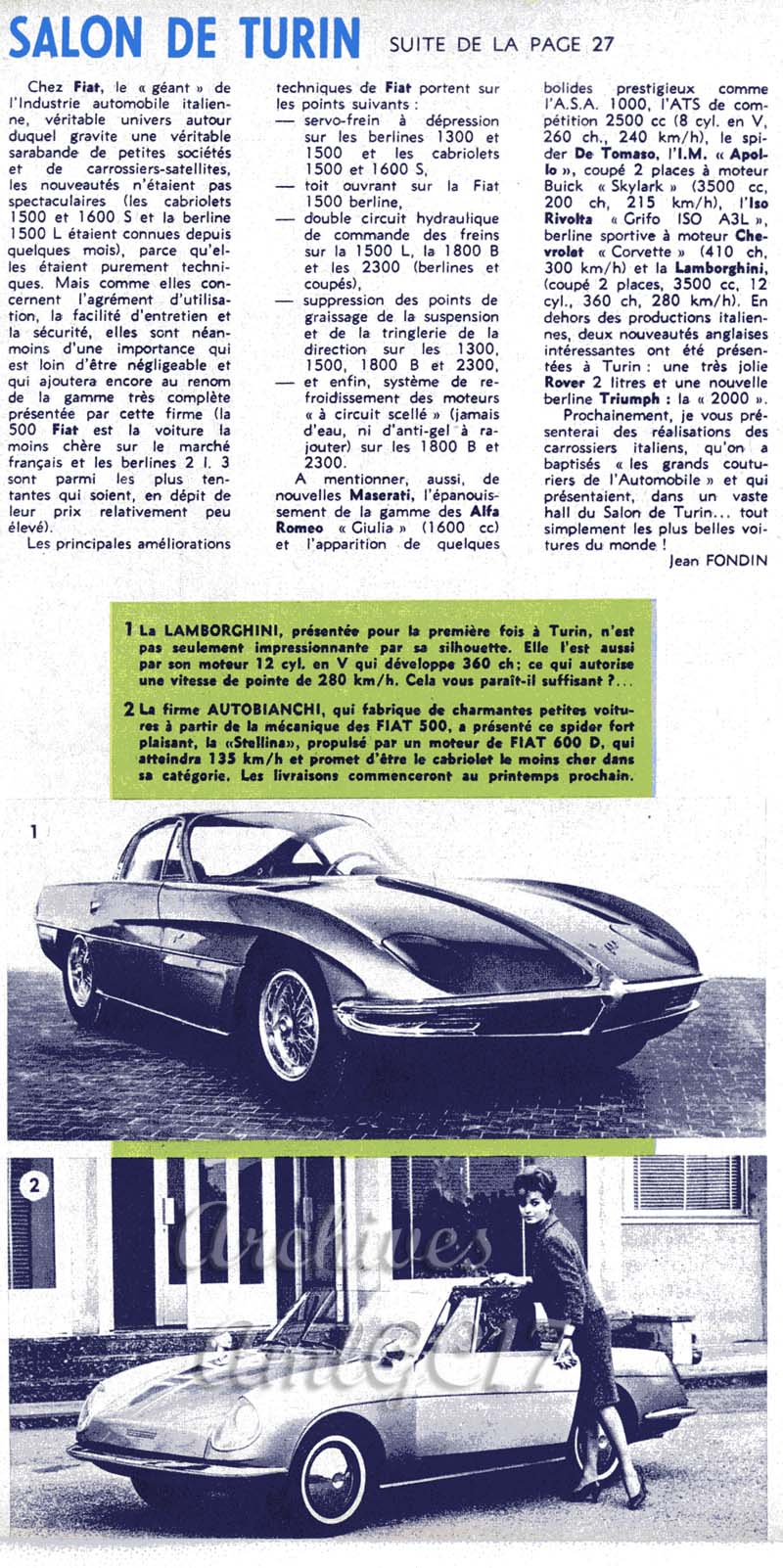
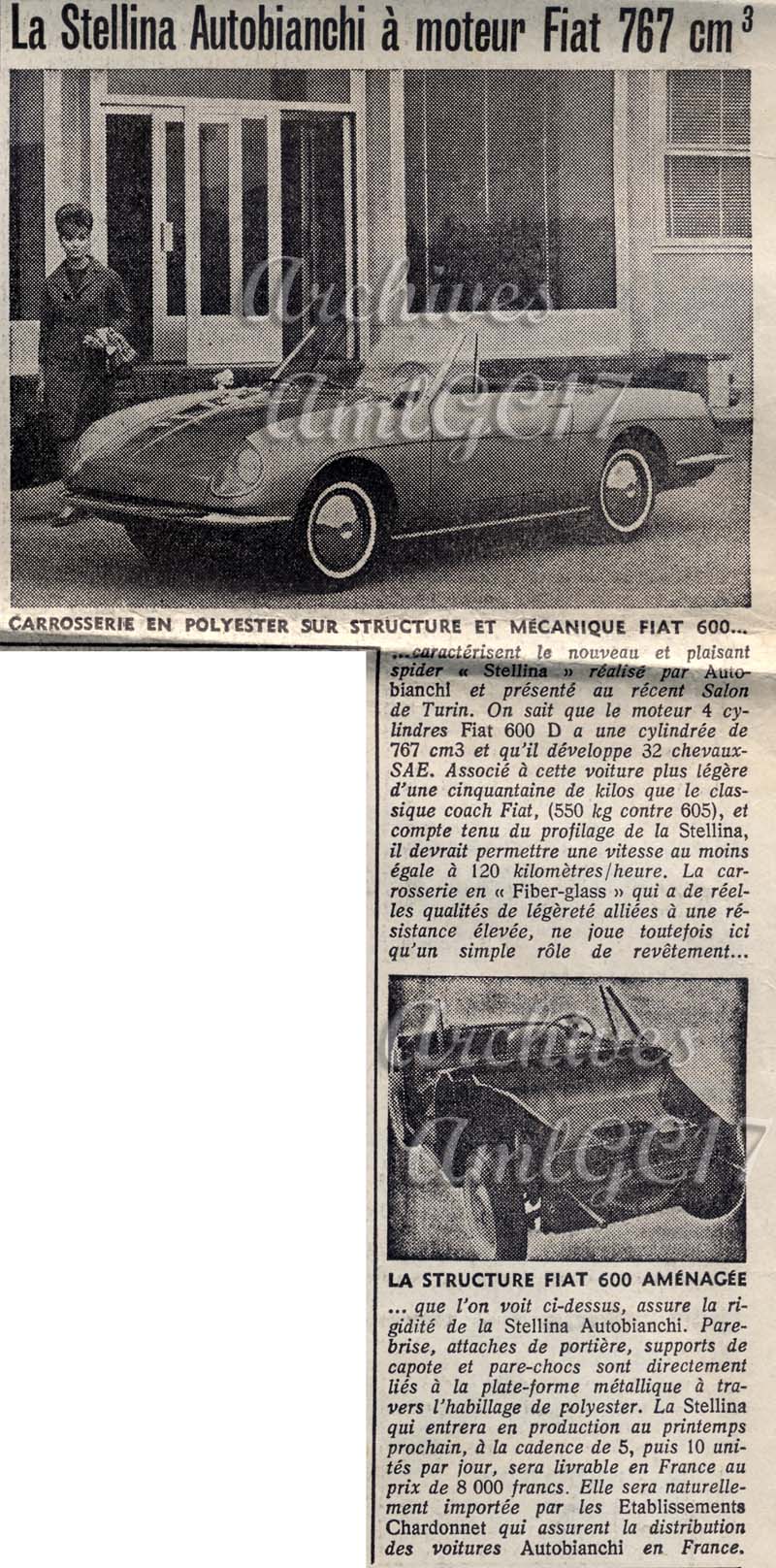
First major French press mention of the Stellina, published shortly after the Turin motor show debut. The article focuses on the Fiat 600 D–derived 767 cc engine, the fibreglass body structure (described as weighing only 550 kg against 605 kg for a Fiat Coach), and a projected top speed of at least 120 km/h. Pricing for France was announced at 8,000 francs through Chardonnet, the Autobianchi importer.
Factory brochures
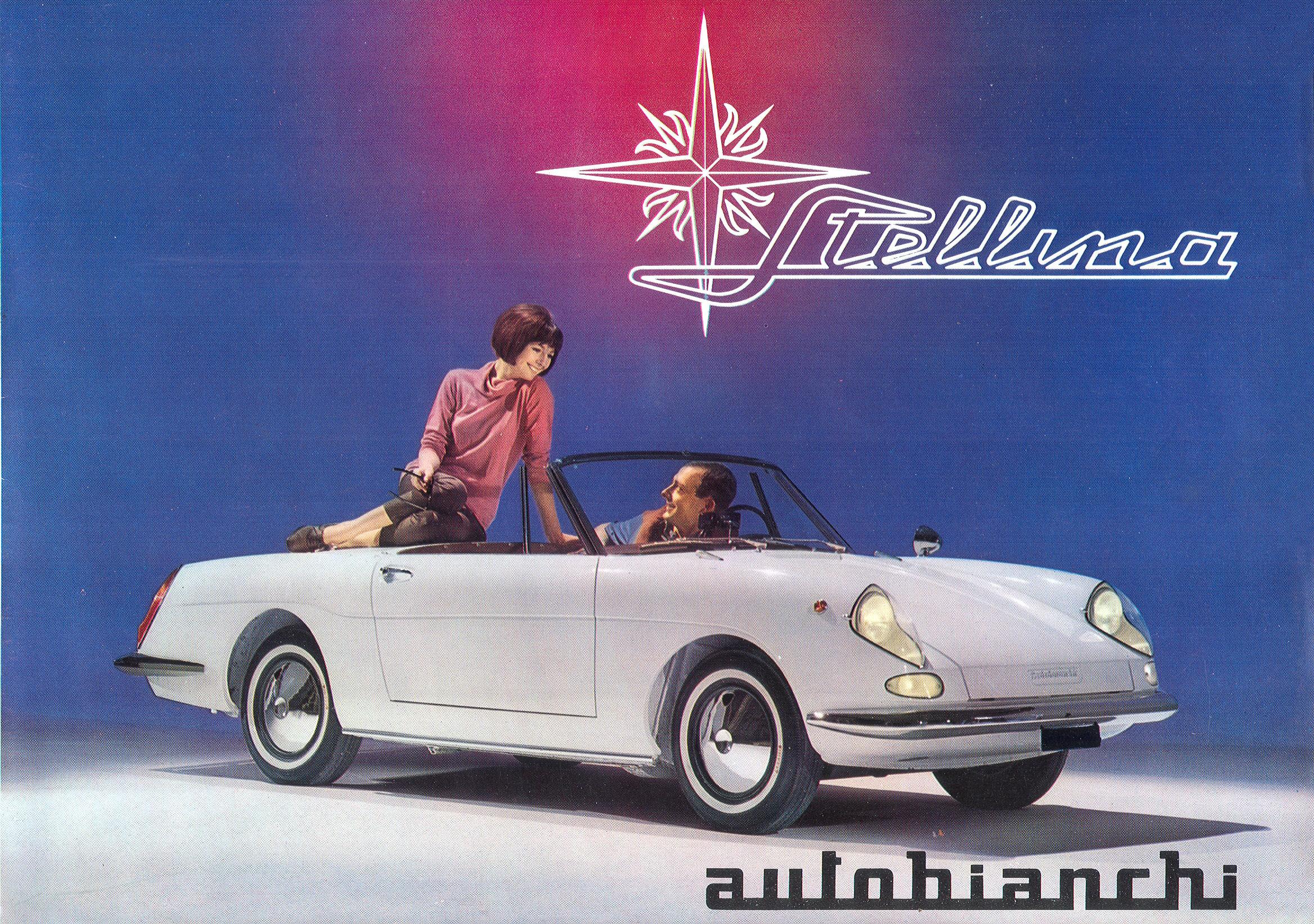
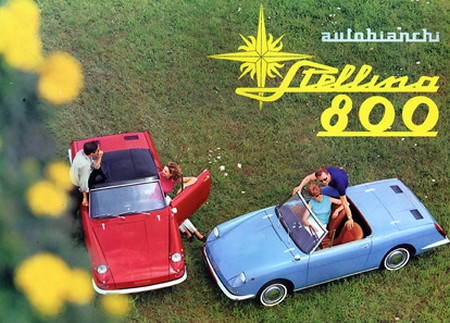
Original Autobianchi promotional material issued for the Stellina at launch and during its production run, 1963–1966.
Press articles
Contemporary and retrospective coverage from the French, Italian and Belgian press. Non-English articles are accompanied by a summary translation.
Turin Salon round-up column that places the Stellina alongside first-ever coverage of the Lamborghini 350 GTV. The Autobianchi section notes the 767 cc engine and promises the Stellina will be the least expensive cabriolet in its category, with deliveries starting the following spring.
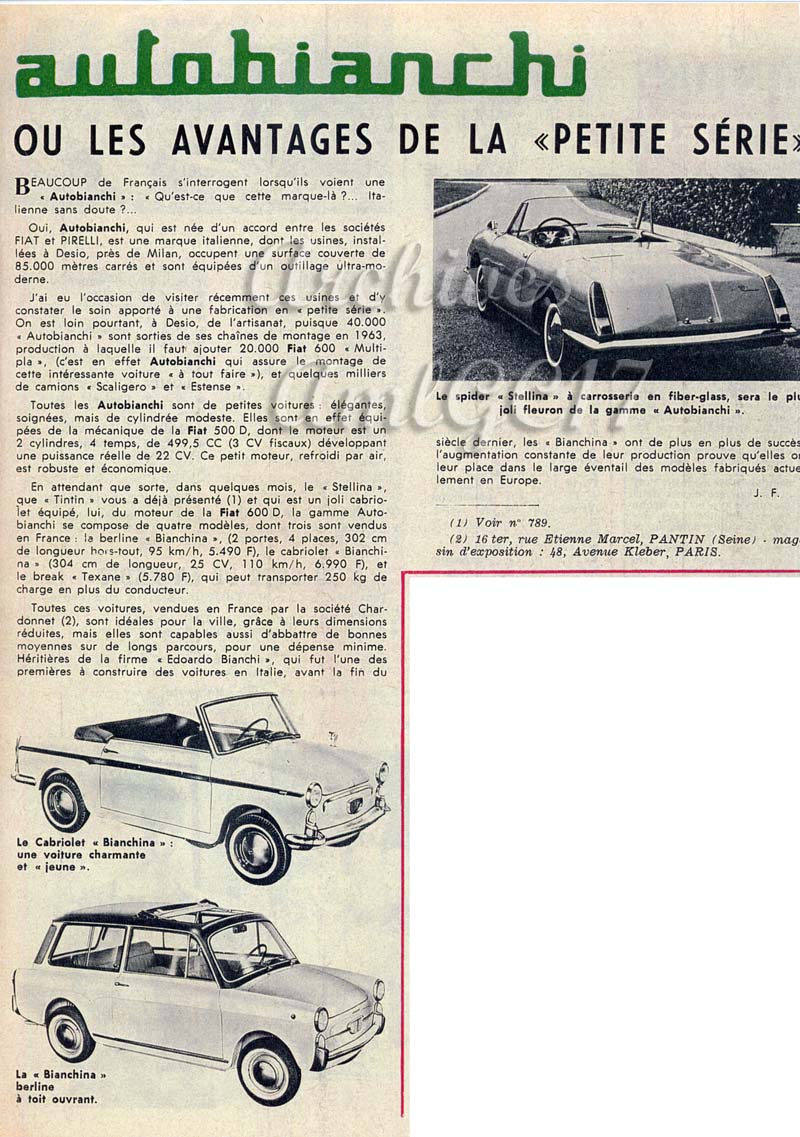
A full feature on the Autobianchi brand for French readers — explaining the Fiat/Pirelli joint venture, the Desio factory and the small-series production philosophy. The Stellina is highlighted as the brand's most exciting model: a fibreglass spider on the Fiat 600 platform, at 499.5 cc (fiscal), expected to be the least expensive cabriolet on the market. Distributed in France by Chardonnet.
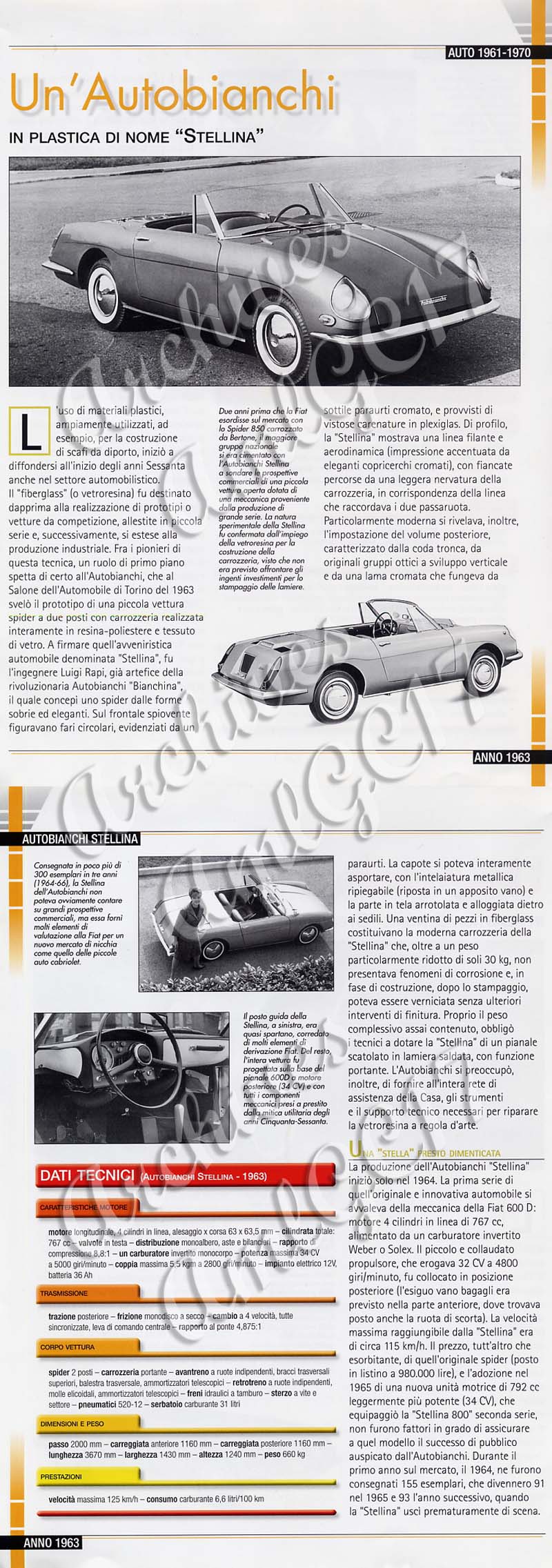
Encyclopedic entry covering the Stellina's origins, design (credited to Luigi Rapi, the engineer behind the Bianchina), and full period technical specifications. Notable for its detailed production data box: 5 cars per day targeted, 300 produced in the first year, final retail price 980,000 lire. The article also traces the Stellina's eclipse by the Fiat 850 Spider and Autobianchi's commercial decision to withdraw it in 1966.
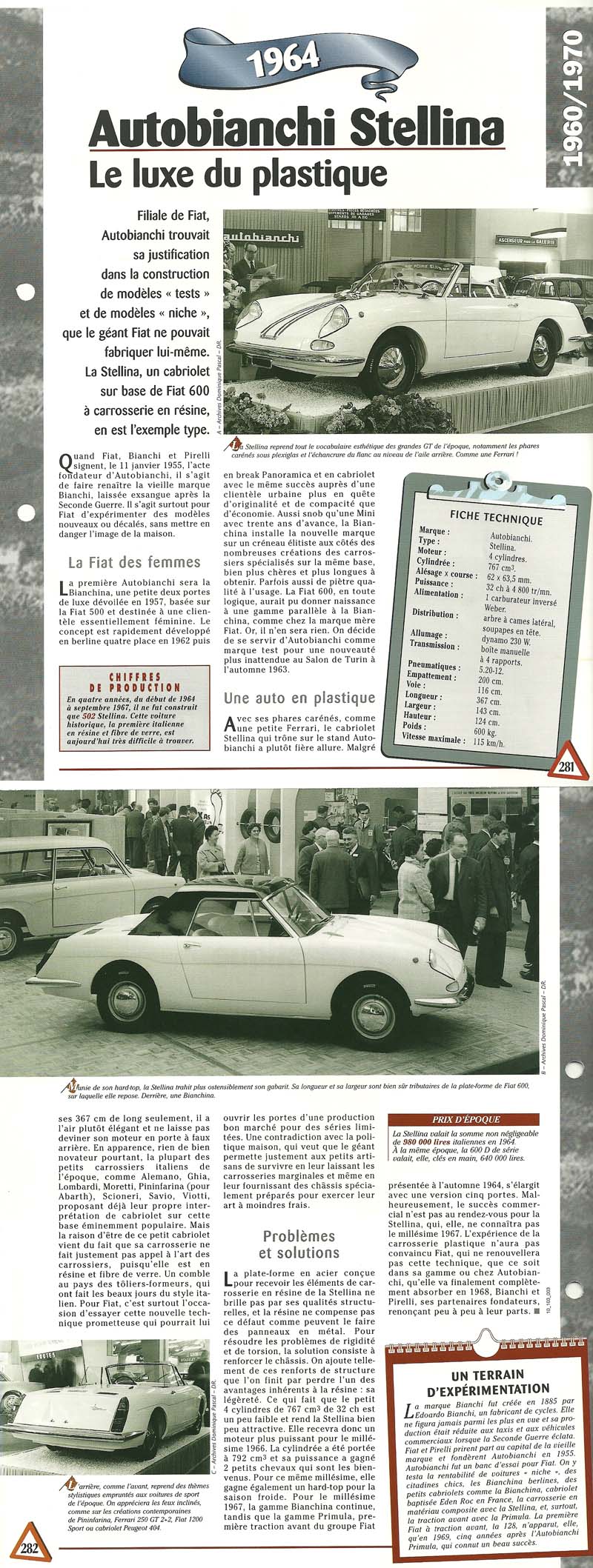
Double-page technical fiche from a major French automotive reference publication. Covers the Stellina's position within the Autobianchi range, its Fiat 600 D–derived running gear and the fibreglass monocoque principle. The data panel lists full dimensions, engine and transmission specifications for both the 767 cc Phase 1 and the 792 cc Stellina 800, plus weights, performance figures and the French retail price.
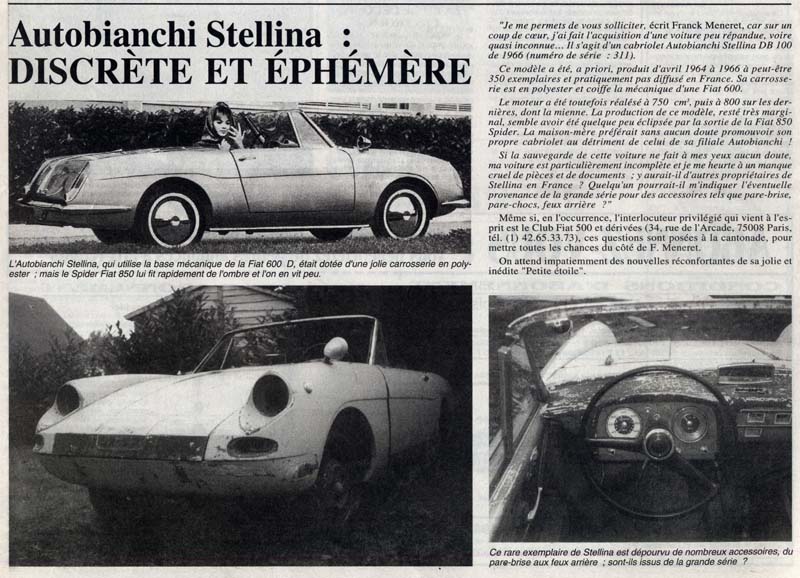
An owner's appeal published in the readers' column. Franck Méneret writes about his acquisition of chassis 100DB-000311 — an incomplete car with a missing windscreen and spare parts. He estimates production at around 350 examples (April 1964 to 1966) and notes the type was barely marketed in France, quickly overshadowed by the Fiat 850 Spider. He asks for contact from other French owners, spare part holders, and the Club Fiat 500 et Dérivés.
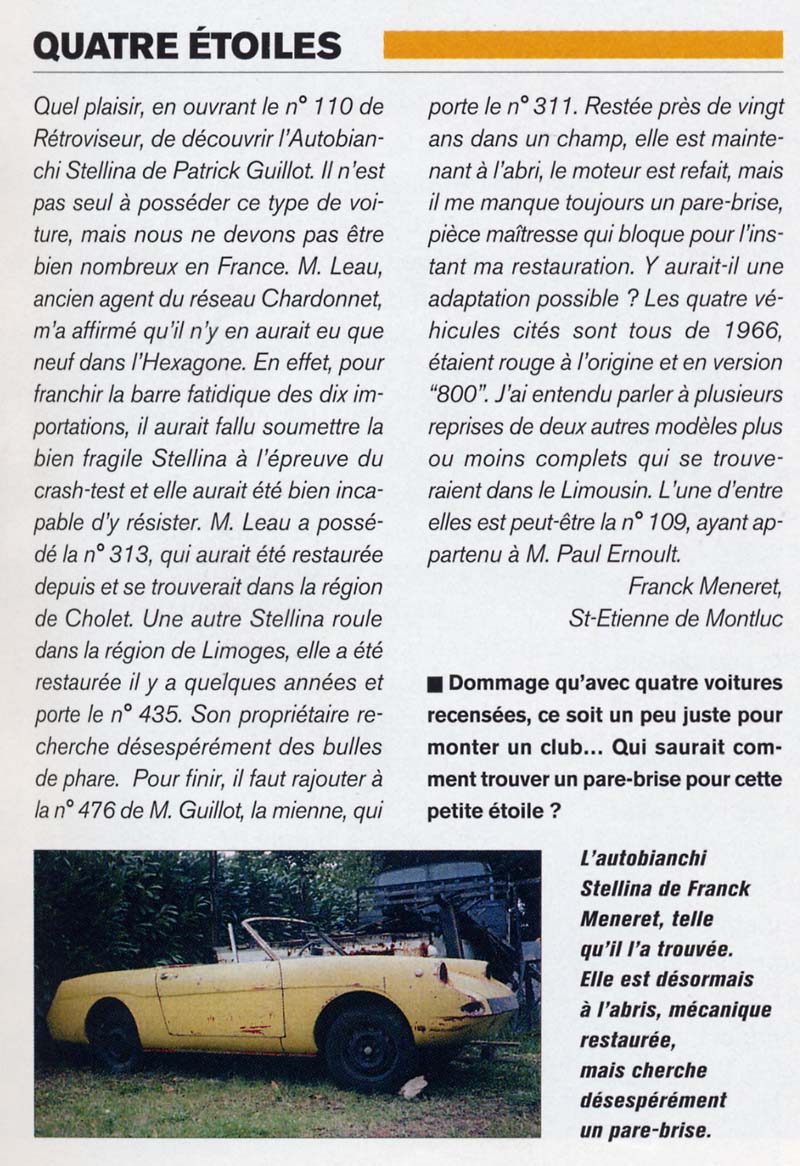
A reader follow-up letter in response to Méneret's earlier appeal, reporting that four Stellinas are now known in France. The author has located chassis 313 (restored, near Cholet), 435 (near Limoges, recently restored), 476 (Guillot, needing a windscreen), and 109 (reportedly belonging to Paul Ernoult). All four examples are 1966 "800" variants finished in red. The letter calls for owners to form a club and mentions the particular rarity of spare front screens.
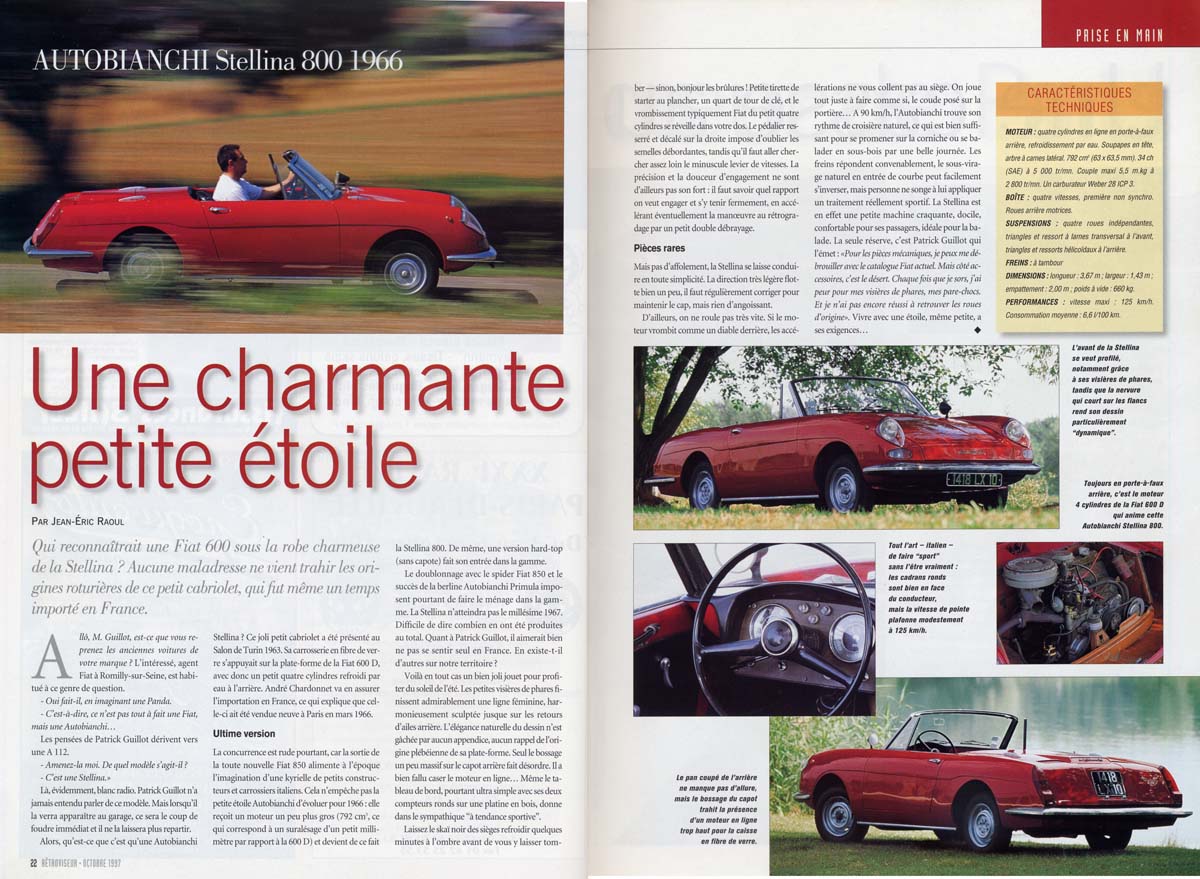
Full retrospective road test by Jean-Eric Raoul, centred on Patrick Guillot's Stellina 800 (chassis 476). The article traces the car's unlikely origins — a cabriolet spider designed without a conventional windscreen or weather protection — and recounts the "ultimate" production-run update to 792 cc which gave the Stellina 800 slightly better performance. The road test itself praises the fibreglass body's remarkably clean condition after 30 years, but flags the 4-speed gearbox (no synchromesh on first) and the high body relative to the Fiat 850 Spider as weaknesses.
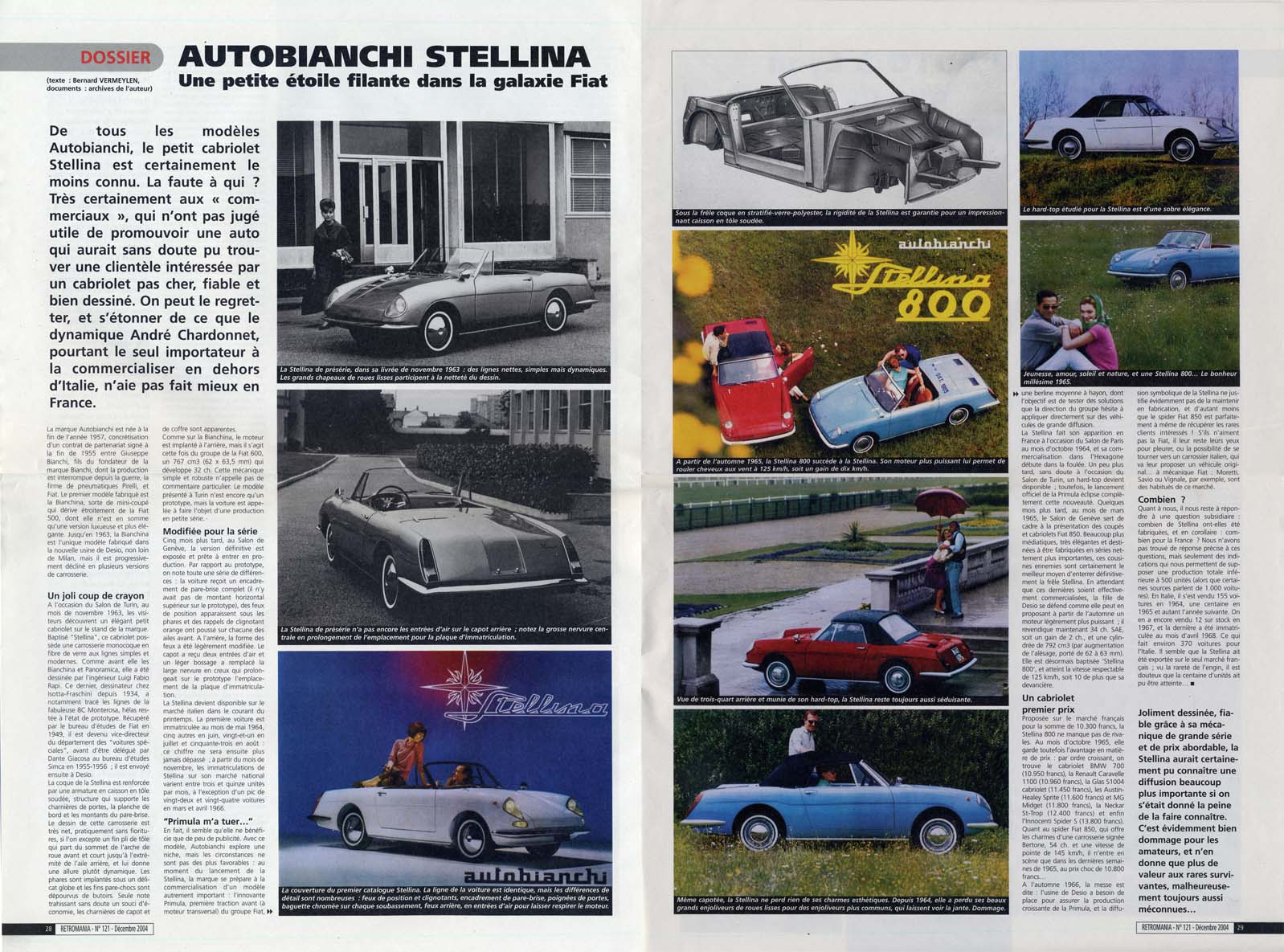
A thorough two-page dossier by Bernard Vermeylen, drawing on the author's own documentation archive. The article covers the Stellina's gestation from the 1962 Primula prototype through to its November 1963 Turin debut, the rationale for choosing fibreglass (a "coup de crayon" design exercise impossible in pressed steel), the two production phases (Phase 1: 767 cc / Phase 2: 792 cc from spring 1965), and the reasons for the car's commercial failure — high cost, modest performance and overshadowing by the Fiat 850 Spider. Includes original factory catalogue images not published elsewhere.
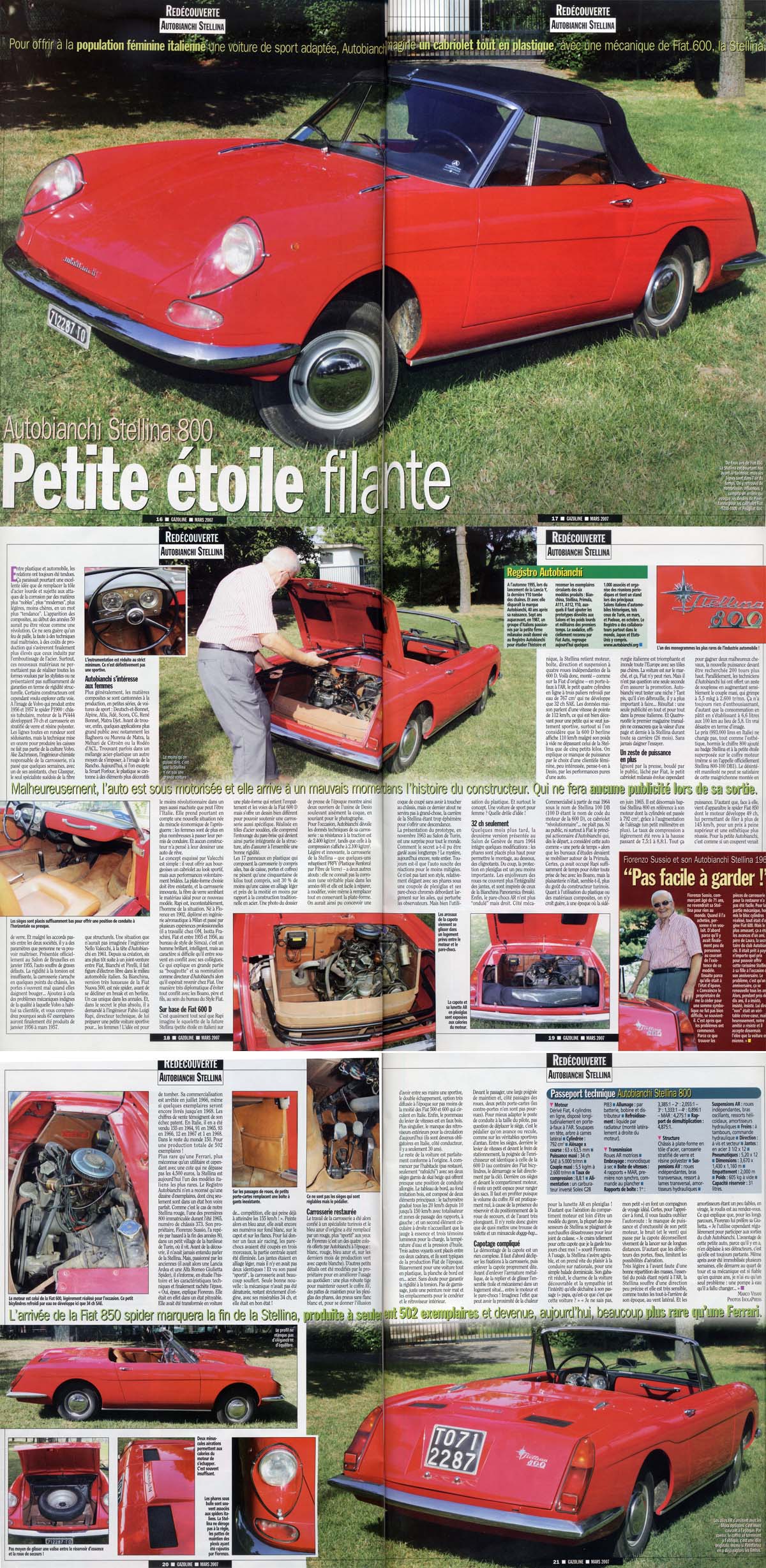
In-depth owner feature on a restored red Stellina 800 (plate 10ZT1-2287). The article covers the car's history from factory to current owner, with a detailed photographic survey of the engine bay, interior and underside. A sidebar titled "Pas facile à garder" (Not easy to keep) addresses the chronic scarcity of spare parts and the near-impossibility of sourcing glass panels and trim. Rated as one of the most evocative and photogenic cars ever to grace the magazine's pages.
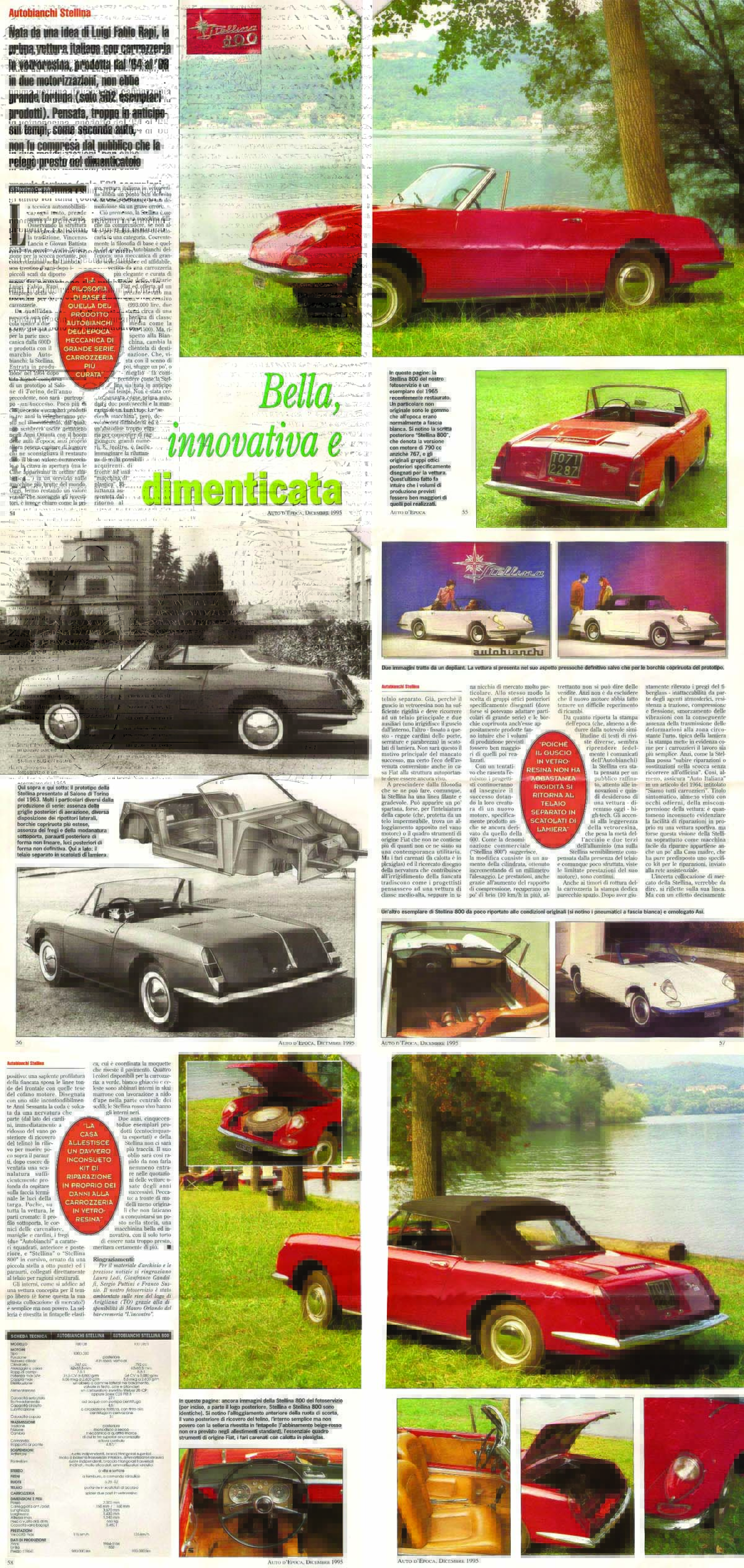
Multi-page feature comparing the original Phase 1 and the later Stellina 800, using archival and contemporary photographs. The Italian text addresses the car's singular position in automotive history as the first Italian production car with a fibreglass body, and laments that its technical innovation was never properly recognised during its lifetime. Includes an original sales brochure image and colour period photographs of both versions.
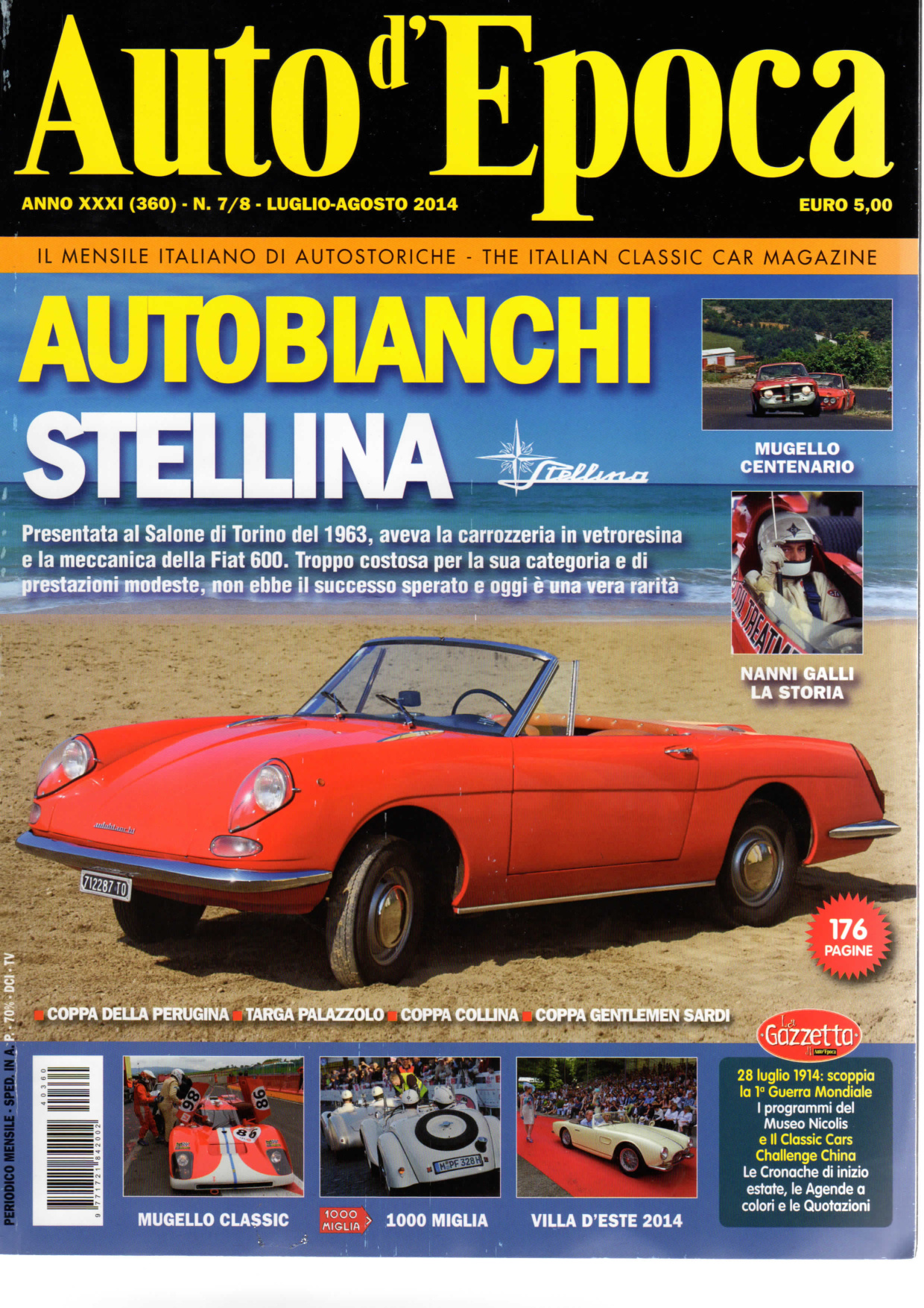
Cover story of the most prestigious Italian classic car monthly, the most extensive and authoritative article ever published on the Stellina. Six pages by Alessandro Passo, drawing on images from the Autobianchi official archive. Page 1 establishes the historical context: the Stellina as Italy's first fibreglass production car, designed by Luigi Rapi on the Fiat 600 D platform and unveiled at Turin in November 1963. Pages 2–3 describe the driving experience and engineering in detail. Pages 4–6 provide an extraordinary technical dissection with exploded diagrams, workshop manual illustrations and a guide to the rare factory accessories (wind deflectors, chrome door handles, side louvres). The article also includes the first published scan of the original owner's handbook.